
Life Science
Advance life-changing products with simulation that protects quality, compliance, and continuity at every step.
Big Picture
Simulation that Protects Quality & Compliance
Life sciences manufacturing operates under strict regulatory oversight, complex process dynamics, and high sensitivity to variability. Even small changes in raw materials, equipment behavior, or automation strategy can impact product quality or batch release. Onyx 360 provides engineering-driven insight into how processes and controls will behave before changes reach production—helping teams strengthen quality, reduce deviation risk, accelerate tech transfer, and improve operational consistency across sites and CMOs.
Case Study
Connected Performance for Life Sciences
Increased Production Runs at Contract Manufacturing Organization (CMO)
Challenge
A contract manufacturing organization (CMO) needed to transition from single-product to multi-product manufacturing, introducing significant process complexity and automation risk that required tighter batch control, faster changeovers, and consistent operator execution. As a fully validated facility, even minor automation or procedural changes carried substantial documentation and testing burdens, creating cost and schedule pressure. The site needed to optimize processes, strengthen batch controls, and reduce validation overhead without disrupting GMP production.
Solution
Our team developed a dynamic Digital Twin capable of supporting end-to-end batch testing across multiple product trains. The model became the foundation of a structured Management of Change (MOC) process, requiring that:
- All automation and procedural changes be tested and verified against the Digital Twin before implementation
- Control strategy improvements be validated in simulation to reduce risk during product transitions
- The Digital Twin itself remain continuously updated to match the live system
This approach allowed engineering, operations, and quality teams to collaborate on batch improvements safely and efficiently, while preserving validation compliance.
Results
- Improved quality of testing reduced the number of required water-batch qualification runs
- Validation support savings > $1M per year, driven by fewer test batches and reduced rework
- Shorter testing cycles allowed the facility to accommodate an additional production campaign in the first year
- More consistent batch performance across operators and shifts
- Reduced risk during transitions between product types
$1M
annual validation
cost savings
Digital Twin used for all
pre-implementation MOC testing
Multi-product batch strategies tested end-to-end off-line
Fewer qualification batches required
Increased throughput:
one extra campaign in year one
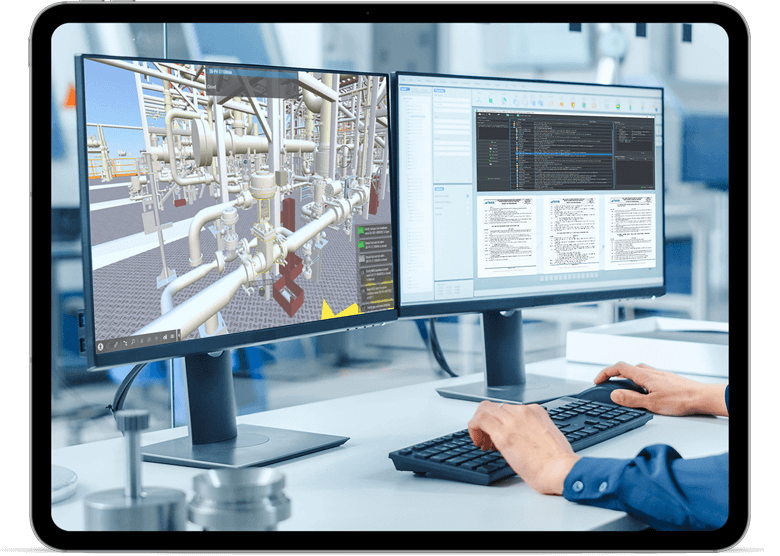
3D Simulation for Life Sciences Facilities
Train operators, validate aseptic workflows, evaluate cleanroom procedures, and test layout or equipment changes in immersive, compliant-ready digital environments.
Benefits
What Life Sciences Teams Gain
Protected Product Quality
Understand process sensitivity and variability before implementing changes.
Enhanced Compliance & Validation
Simulate and document procedures with traceability built in.
Lower Risk During Scale-Up
Predict behavior from lab to pilot to full-scale manufacturing.
Reduced Deviations & Batch Failures
Surface issues early to keep processes stable and predictable.
Faster Tech Transfers
Model differences between equipment, sites, or trains.
Optimized Use of Resources
Reduce waste, improve yields, and refine energy or media usage.
Better Operator Readiness
Train teams safely for complex or aseptic tasks.
Consistent, Enterprise-Wide Execution
Standardize processes across rooms, suites, and global facilities.
Use Cases
Where Connected Performance Delivers Impact
- Mixing, agitation, and mass transfer optimization
- Fermentation and cell culture modeling
- Cleanroom and aseptic workflow validation
- Equipment transitions and scale-up planning
- Environmental control and HVAC impact analysis
- Operator onboarding and contamination-prevention training
- Facility expansions and new equipment integration
- Digital twins for continuous bioprocess monitoring