


What happens when better tools give engineers more time to focus on the work that matters?
There is no shortage of opinions on what AI means for the workforce, and that includes Engineering. A lot of the conversation centers on AI as a replacement; if software can do something an engineer does today, does that mean we need fewer engineers tomorrow?
We at Onyx 360 see something different happening. Our view is relatively simple: AI tools are a skills multiplier, the more skilled the person the more these tools can amplify their human capabilities.
An engineer who understands engineering and industry processing knows what information matters, what assumptions are reasonable, and when an answer simply doesn’t make sense. Giving that engineer better tools doesn’t make their expertise less valuable. It gives them more leverage.
The interesting question then becomes what we do with that leverage.
Engineering the engineering learning process.
When I (Zach) was a co-op at MYNAH Technologies, a large portion of my time was spent reviewing engineering datasheets and entering that information into simulation models. The first few times were interesting. I was learning what was in the documents, how the pieces fit together, and how those inputs affected the model.
After enough repetition, I was no longer learning much by typing inputs into datasheets. But this is what ALOT of day-to-day engineering work that looks like: Finding information, moving it between systems, configuring tools, checking documentation, and updating models. Repeating tasks because two pieces of software don’t communicate particularly well. Some of this work is necessary. Very little of it is where an engineer creates the most value.
This is where I think the impact of AI becomes much more interesting. Rather than simply using it as a tool to make existing tasks faster, what if we agreed that dramatically reducing the effort required to configure and maintain engineering technologies means that engineers can spend more time applying AI to solve problems?
Lowering the barrier for better engineering technologies
We design dynamic simulations, also known as Digital Twins, every day. There are a lot of process industry challenges where simulation can be used to help someone make a better decision. The limitation has historically been whether the benefits of simulation justified the engineering effort required to build and maintain the solution. That same problem exists across a much broader set of technologies.
Advanced analytics may have a strong use case, but someone must organize and contextualize the data. A knowledge system may be valuable, but someone must capture and maintain the information behind it. Simulation can answer difficult engineering questions, but someone must create the model first.
As the effort required to implement and sustain these solutions comes down, the number of instances where they make business sense goes up.
This is a significant shift in our industry. We aren’t just talking about doing the same Digital Twin project faster. We are talking about applying simulation, advanced analytics, engineering knowledge, system optimization, and other transformative technologies to solve problems where a business case may not have existed before.
This opens the door for engineers to use much more sophisticated tools as part of their day-to-day work. There isn’t a shortage of things for engineers to do. And it’s a common misconception that as engineers become more productive, an organization needs fewer engineers.
But most process manufacturers we work with have more tasks to accomplish than they have resources available to engineer them. Projects take priority over improvement initiatives. New technology gets pushed out because the engineering team doesn’t have time to support it. Valuable ideas sit on a ‘nice to have’ list because something more urgent always comes up.
Today, nearly everyone is being asked to do more with less.
Making engineers more productive doesn’t eliminate that backlog. It gives them a better opportunity to work through it. This might mean that engineers spend more time optimizing a process instead of collecting data. It could mean using simulation on a smaller project where it previously wasn’t economical. It could equate to the ability to evaluate three ideas instead of having barely enough time to evaluate one.
The opportunity isn’t simply getting today’s work done faster; it’s increasing the value of the engineering work we are capable of doing.
Here’s the catch: the way engineers learn is changing.
There is another important part of my co-op experience that is relevant for this discussion. Entering those datasheets wasn’t the highest-value thing I did for the company, but I wouldn’t have learned how to build models any other way.
I learned what type of information engineers put on a datasheet. I learned what inputs matter when creating an accurate simulation. I started recognizing what typical parameter values should look like. Eventually, I could look at something and realize it was likely incorrect.
A lot of entry-level engineering development works this way. You start with simpler tasks. You repeat them. You build context. Over time, you develop enough contextual understanding to take on more complicated challenges.
As some of the simpler work disappears, companies cannot assume that the learning that came with these redundant but necessary actions will magically remain.
This will require a concerted effort in changing how companies onboard and develop engineers. The old learning model could afford to be passive. Give someone progressively harder work over several years and let their experience accumulate.
The next model will have to be much more intentional.
Learn the fundamentals first. Then use the multiplier.
Onyx 360 hires more engineers directly out of universities than most companies because the nature of our work directly maps to the engineering fundamentals students learn in school. We built our entry-level training program using an intentional learning model and leverage this methodology to onboard new engineers.
That is to say: our entry-level onboarding program purposefully begins without the use of AI tools. Engineers learn simulation fundamentals by working through the engineering. We believe they need to understand exactly how the model works and why before we give them tools that can help them do it faster. Once they have established this foundational knowledge, they progress to solving more complicated challenges where these tools become part of how they solve problems.
The objective isn’t to keep new engineers away from modern technology. We want them to first understand the fundamentals. Then, we immediately equip them with AI tools and begin a deeper mentoring process that offers them access to the wealth of engineering, software, and industry expertise that exists across our organization. We hire experienced simulation and engineering specialists because deep expertise is invaluable, particularly when technology can multiply its reach. Highly skilled team members consistently teach our AI tools how to perform and what we expect to see in terms of output. Knowing that entry level engineers are solving challenges using tools that have been trained by experts, affords us more security than knowing they are using ‘out of the box’ software.
Connecting our experts with next generation of engineers and enabling them to explore innovative ideas and build solutions together using powerful tools gives us an edge. And they have a lot of fun doing it!
Experienced engineers also have a new responsibility.
Developing a next generation engineering workforce isn’t only an entry-level problem. This is because a tremendous amount of engineering knowledge still exists in people’s heads.
Why was the solution designed this way?
How did we try to solve this five years ago?
Which number in the calculation actually matters?
What looks acceptable on paper, but causes problems in the plant?
This is the tribal knowledge every organization worries about losing when their experienced engineers retire.
Today, simulation and AI-enabled tools allow us to document this type of information and make it available across an organization. However, these solutions are only as useful as the information behind them.
Someone still has to capture this information. Someone has to provide context. Someone has to recognize when the information needs to change. If the solution does include AI, someone also has to reteach the tool.
Knowledge capture has become a bigger part of everyone’s job. It’s not documenting your job away, but capturing what you learn so the next person doesn’t have to learn it from scratch.
In our approach, every engineer becomes a curator of engineering knowledge. We believe organizations that do this well will have a distinct competitive advantage because each new lesson can become available to everyone rather than staying with the person who happened to learn it along the way.

Connecting the AI dots.
Understandably, there is a lot of discussion about what AI means for engineering careers. Guess what? Engineering fundamentals, experience, and judgment still matter.
What is changing is the leverage AI can give engineers. But this also means that companies have work to do. As the barriers to using more sophisticated technologies continue to fall, we must rethink how we develop new engineers, get better at capturing the knowledge of experienced engineers, and be willing to change how work gets done,
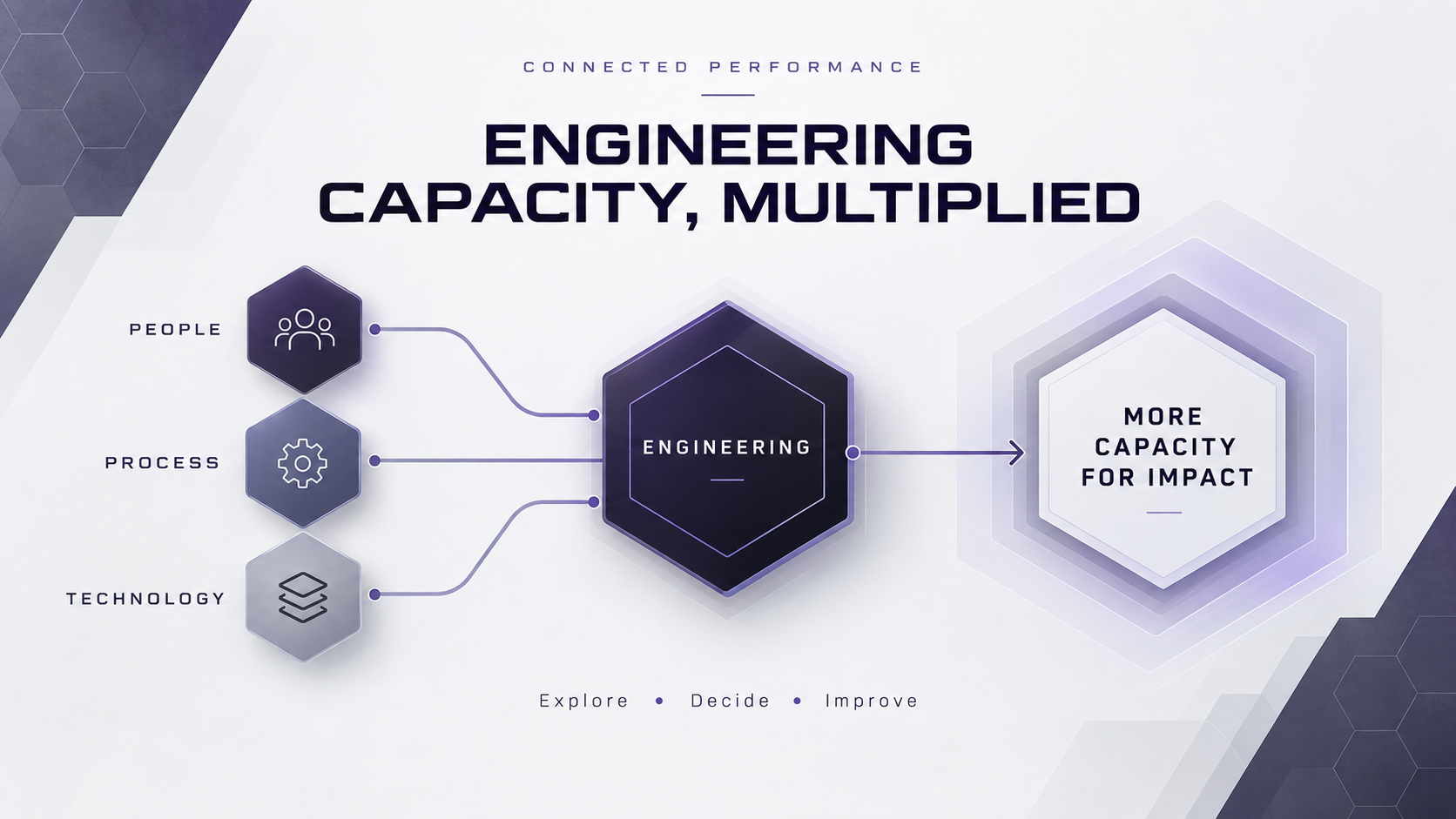
At Onyx 360, we use the term Connected Performance to describe how our full circle solutions connect technology, people and processes. This same principle applies to how we are building our company.
Technology such as AI is only one part of the equation. Tremendous opportunities exist when we connect technology with the right engineering knowledge and put it in the hands of people who know how to use it. This is the future of engineering we’re excited to be building.
Visit our careers page to learn more about exciting available roles with Onyx 360.